D4L Collect
Easily collect data from sensors and wearable devices in your digital health studies.

Do you already know D4L Collect? Our explanatory video will give you a quick overview.
D4L Collect lets you simultaneously collect multimodal patient-reported and sensor data and integrates it seamlessly into a unified dataset.

Set up and manage your studies in our web app
- Set up an entire study within minutes using a no-coding configuration wizard
- Keep track of participation and explore point-in-time data
- Download study data for further analysis or access at any time

Your study participants collect data in a mobile app
- Manage study participation by interacting with a single app
- Simplify device connection with our step-by-step guide
- Engage participants with configurable notifications and in-app messages
Data points and signals
Which data points and sensor signals can already be collected with D4L Collect, and what’s coming next?
Explore our continuously growing ecosystem of wearables, sensors, and data integrations.

Feature comparison between D4L Collect and selected related platforms
Explanations
(a) REDCap is source-available to nonprofit institutions through the REDCap Consortium and is not open source under the OSI definition.
(b) Castor is primarily a SaaS platform; on-premises deployments are available under enterprise agreements.
(c) Spezi is a Swift framework: researchers build the backend and study-management surface around its modular components.
(d) REDCap exposes a FHIR API for read access but does not use FHIR as its internal data model.
(e) D4L Collect currently provides English and German app interfaces; per-study content (consent, questionnaires, PROMs) can be provided in arbitrary languages by the study team.
(f) RADAR-base provides a web-based Management Portal for researchers, but participant data collection is performed through the mobile applications.
(g) The web interface of D4L Collect supports questionnaire-based data collection only; sensor and wearable data collection require the mobile app.
(h) This row describes the participant-facing client only. Wearable and smartphone-sensor data ingestion is a separate platform-layer capability and, for REDCap and Castor, is achieved through cloud-to-cloud API integration with vendor platforms (e.g., Fitbit Web API, Garmin Health API, Apple Health) and through companion mobile apps, independently of whether participants complete tasks via the browser.
(i) REDCap and Castor support discrete, user-initiated artifacts captured at form-submission time (e.g., photo or audio attachments, geolocation tagging) through external modules or form-action tags, but neither natively performs continuous background sensing on the device.
(j) RADAR-base is historically Android-first; iOS support was added later and currently covers a narrower set of passive sensor streams.
(k) Open-source release under the Apache License 2.0 is in preparation; publication is pending a legal review required by Data4Life's nonprofit status.
The comparison reflects the typical out-of-the-box capabilities of each platform; in practice, all of the open platforms can be extended.
D4L Collect Flyer
Want a compact overview of D4L Collect?
Our new flyer brings together the essentials and detailed features of the platform – from easy configuration to real-world-data-collection – all in one place.
Download Flyer
Benefits of D4L Collect at a glance
Seamlessly conduct and manage digital health studies
Simplify the entire research process with paperless consent management, digital questionnaire design, and point-in-time data.
Integrate wearables and professional sensors in your research
Collect raw data from laboratory-grade sensor devices and common wearable devices through a single application.
Access all your study data from one application
Receive participant-generated data in interoperable formats, reducing time and effort needed to prepare research-ready data.
Keep full control of your study's data
Maintain full control of data collection and storage, enhancing privacy and compliance.
Digitize your study – easily and securely.
D4L Collect helps you capture high-quality data from wearables, sensors, and questionnaires – fully standardized and GDPR-compliant.
Just fill out the form – and we’ll get back to you shortly to learn more about your project.
Your benefits with D4L Collect:
- Efficient setup: No-code study builder and digital consent management.
- Deeper insights: Combine sensor data with PROMs in one unified platform.
- Research-ready: Centralized, standardized, and interoperable datasets.
We look forward to supporting your research!
Related articles
How to add SAP HANA to WebAPI
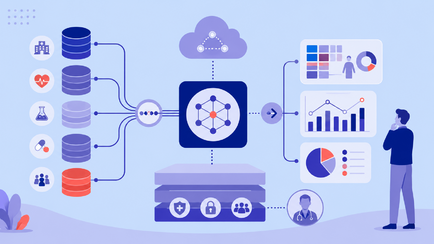
A step-by-step guide to adding SAP HANA support to OHDSI WebAPI for querying OMOP Common Data Model databases.
Leveraging the OHDSI OMOP common data model for research using observational health data
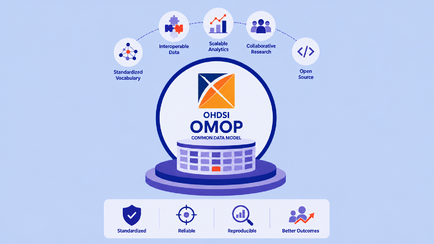
Learn how Data4Life uses the OHDSI OMOP common data model to enable standardized, scalable, and reproducible observational health data research.